Ultra Processed Foods: The Biggest Threat to our health and vitality.
They drain energy, hijack appetite, and drive metabolic chaos. Learn how to spot them fast, what they do under the hood, and simple swaps that restore real food and real control.
5/8/202414 min read
Health and Wellness
📍 Introduction: UPFs — The Primary Culprit in Keeping Us Surviving Instead of Thriving
Let’s cut to the chase. Ultra processed foods are one of the greatest threats to our health today. These are not just junk foods. They are engineered consumables designed for addiction, overconsumption, and profit. Behind the flashy packaging and convenience is a darker truth. Ultra processed foods are draining our energy, dismantling our biological resilience, and keeping millions of people stuck in survival mode instead of living a life where they can truly thrive.
Starving in the Midst of Plenty
Ultra processed foods scramble the signals your body depends on. They do not deliver the raw materials or biological cues your system needs for satiety, hormone balance, repair, or resilience. They fill the stomach but starve the system, leaving behind fatigue, cravings, irritability, and long term breakdowns in health.
As Dr. Mark Hyman warns, we have become “overfed and undernourished.” That is the paradox of the modern diet, endless abundance of engineered calories stripped of the very medicine that makes food powerful. As Hyman puts it, “Food is not like medicine, it is medicine” (Hyman, 2020). Every bite sends instructions to your body, either pushing you toward healing and vitality or nudging you toward disease.
Food is Information
Shawn Stevenson drives this home in Eat Smarter when he explains that food is more than macros and calories, it is information. “Food is not just food, it is information. Every bite of food you eat is changing your genetic expression and making an impact on your health” (Stevenson, 2020).
Each meal is like a data packet uploaded into your cells. The quality of that information determines how well your mitochondria, the tiny power plants in every cell, generate energy. When they get the right fuel, you do not just survive, you thrive. Energy climbs, focus sharpens, mood lifts, hormones balance, and your immune system strengthens.
Food is Medicine
Food is medicine. It is not neutral. Every bite is either medicine or a slow acting toxin.
📉 The Devastating Impact of UPFs
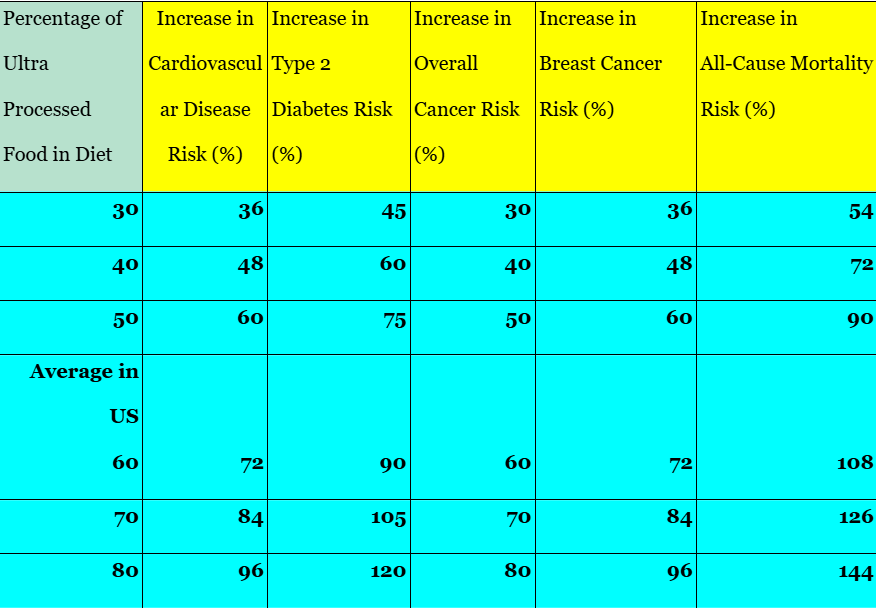
Let’s put numbers on it. On average, 60% of calories in the American diet come from ultra processed foods. For children, it is even worse, closer to 70%. That means the majority of what we eat is engineered junk that dismantles our health one bite at a time.
The science is clear. As UPF intake climbs, so does the risk of nearly every chronic condition we fear most. Cardiovascular disease, type 2 diabetes, cancer, breast cancer, infections, obesity, asthma. You name it, the risk rises in lockstep.
And what is not shown in these numbers is the impact on thriving in everyday life. If UPFs raise the risk of every disease, imagine what they are doing to daily energy, focus, mood, and overall quality of life. The cost is not just years off the end of life, but vitality stolen from the years you are living right now.
Food is medicine or poison.
📉 The Devastating Impact of UPFs
Studies have shown a direct correlation between UPF consumption and increased health risks:
The numbers are staggering and paint a crystal clear picture. Ultra processed foods are not just harmful, they are catastrophic when they make up the majority of your diet. With the average American getting 60% of their calories from UPFs, we are seeing a full scale assault on metabolic health.
What makes me furious is this: why is this not mainstream knowledge? I have been a nurse for 25 years and never once heard this discussed. Why aren’t these charts plastered in every doctor’s office, every school cafeteria, and every clinic? Why didn’t my doctor ever warn me? The truth is uncomfortable. Big Food has massive lobbying power, and it has infiltrated the very institutions we are supposed to trust. From the American Medical Association to the American Heart Association, the Academy of Nutrition and Dietetics, and even the USDA dietary guidelines, corporate money steers the message. Processed food companies fund research, sponsor educational materials, and even sit on advisory boards that shape public health policy.
🧨 This Is More Than Just Food—It’s a Systemic Attack on Health
Ultra-processed foods (UPFs) aren’t just unhealthy, they’re strategically engineered to keep you hooked. These aren’t accidental creations. They are the result of deliberate, calculated design meant to hijack your biology and rewire your brain.
UPFs are crafted to:
Hijack dopamine and reward signaling
Disrupt satiety hormones like GLP-1, leptin, and ghrelin
Fuel inflammation and metabolic breakdown
Make you want more—even when you're full
“These aren’t calories—they’re chemical messages.”
— Shawn Stevenson, Eat Smarter
🎯 The Bliss Point: Engineering Cravings by Design
At the heart of this manipulation is the concept of the bliss point, developed by food scientist Howard Moskowitz. It describes the perfect mix of sugar, salt, and fat that maximizes pleasure and lights up the brain’s reward center like a slot machine jackpot. Once your brain gets that hit, it demands more.
Food companies pour millions into this science. They hire teams of researchers and use advanced flavor testing. They run deep consumer analytics. They fine tune texture, taste, and mouthfeel to override satiety signals.
The result is products that do not just taste good. They override your body’s natural stop signals, keeping you eating habitually and often without even realizing it.
🧠 Insider Proof: Calley Means Calls It Out
Calley Means, a former food and pharma consultant turned whistleblower, has openly described how these companies use neuroscience not to nourish—but to addict.
“I helped food companies target low-income communities with addictive junk, and I watched as they funded front groups to promote them as healthy. The public never stood a chance.”
— Calley Means, 2023–2024 interviews and op-eds
He has repeatedly stated that Big Food follows the same blueprint as Big Tobacco:
Buy the science
Pay the experts
Manipulate the message
This isn’t just about poor-quality food. It’s about manipulating biology, eroding willpower, and prioritizing profit over public health.
🔥 Big Tobacco’s Legacy in Our Food
In the 1980s, tobacco giants like Philip Morris and R. J. Reynolds bought out major food brands including Kraft, General Foods, and Nabisco. By 1990, these companies had become the two largest food manufacturers in the world (Moss, 2013; The Guardian, 2023).
They did not just bring money, they brought strategy. The same addiction science used to sell cigarettes was applied to the food supply, creating hyper palatable products that lit up the brain’s reward systems with laser precision (Mercola, 2022; Moss, 2013).
Even after the tobacco industry divested from food, their blueprint stuck. Today’s food landscape, shaped by bliss point engineering, aggressive marketing, and addictive formulations, mirrors the tobacco era of the 1950s, when public health was an afterthought (Neuroscience News, 2023; University of Michigan, 2023).
The science is not in question. These are high quality studies published in journals like BMJ and JAMA Internal Medicine. They are based on large cohorts with long term follow up and clear dose response relationships. They control for confounding factors and use detailed dietary data. The conclusion is undeniable: the higher your UPF intake, the greater your risk for diabetes, heart disease, cancer, immune dysfunction, and early death.
And it is not only about avoiding disease. It is about quality of life right now. UPFs rob you of energy, focus, mood, and resilience. They keep people stuck in survival mode instead of living with vitality.
The good news is this: even small reductions in UPFs can create big improvements. You do not have to be perfect to see progress. Each step toward real food is a step toward reclaiming energy, strength, and health.
The references are at the end. Read them. Then ask yourself the most important question: who benefits when you stay sick, and who profits when you thrive?
🍔 What Are Ultra-Processed Foods (UPFs)?
UPFs are industrial products made with little to no whole food. They're hyper-palatable, shelf-stable, and nutritionally stripped. Loaded with refined starches, inflammatory oils, synthetic additives, and sugar, UPFs fall under Group 4 of the NOVA food classification system—the highest level of industrial processing.
These aren’t foods your grandmother would recognize. And they’re certainly not something you'd cook at home.
In this blog, you'll learn:
What defines a UPF: The 3 Amigos + Additives
How UPFs disrupt your metabolism, hormones, and brain
How to recognize and reduce UPFs
Tools to reclaim your health through real food
1️⃣ Refined Carbohydrates
Let’s set the record straight. Carbs are not the enemy. Whole food carbs like fruit, vegetables, beans, potatoes, oats, and quinoa are packed with nutrients and belong in a thriving diet. What wrecks our health are refined grains and ultra processed carbs. They are stripped of fiber, nutrients, and anything remotely beneficial, leaving behind fast digesting starches that spike insulin, fuel cravings, and promote fat storage.
Refined grains are the backbone of junk food and UPFs. They are cheap, shelf stable, and engineered to keep you coming back for more. These empty carbs are found in nearly everything lining the middle aisles of the grocery store such as chips, crackers, breakfast cereals, pastries, snack bars, frozen dinners, and yes, most breads.
A Wolf in Wheat Clothing
And let’s be honest. Bread is everywhere. Burgers, sandwiches, subs, wraps, pizza crusts. Most people eat it daily and believe they are choosing healthy by grabbing “whole wheat” or “multigrain.” The reality is that most of these are still ultra processed, made with refined flour, additives, and glyphosate sprayed wheat.
If you actually read the ingredients, many of these loaves are the nutritional equivalent of snack cakes or cookies. Some have nearly as much added sugar as the desserts people think they are avoiding. The result is bread that spikes insulin, disrupts the gut, and leaves you hungrier, not healthier.
Examples:
White or enriched flour
Corn syrup, maltodextrin
Modified starches, puffed grains
The problem is not carbs themselves but the way they have been industrialized and stripped down to create products that no longer resemble food. This is why so many people experience energy crashes, hunger soon after eating, and the slow creep of fat gain and metabolic dysfunction.
🧠 “These carbs disrupt leptin and insulin, driving hunger and fat storage.” — Eat Smarter, Shawn Stevenson
✅ What to do instead: Choose carbs in their natural form such as fruits, vegetables, beans, potatoes, oats, and quinoa. If you want bread, look for sprouted grain options like Ezekiel 4:9 or real sourdough from a local baker using quality ingredients. These retain fiber, nutrients, and integrity that actually fuel your body instead of breaking it down.
2️⃣ Seed Oils — The “Hateful 8”
Before we dive in, let’s acknowledge this is a controversial subject. While the evidence is not perfect and some professionals still argue that seed oils are harmless or even beneficial, an increasing body of research — and a growing number of respected experts — are raising red flags.
Are seed oils inherently problematic? Or are they just components of the toxic blend we call ultra processed foods? Either way, why take the chance when most products containing them are junk in the first place?
These industrial oils are extracted using high heat, chemical solvents and deodorization and marketed as heart healthy alternatives. Yet emerging critiques link them to chronic inflammation, oxidative stress and impaired metabolic health.
The “Hateful 8” to avoid:
Soybean
Canola
Corn
Sunflower
Safflower
Cottonseed
Grapeseed
Rice bran
Why they are problematic:
High in omega 6 linoleic acid: Excessive intake can disrupt the body’s omega 6 to omega 3 balance, promoting chronic inflammation (as critics argue) Oils & Fats International+12CBS News+12Mark Hyman, MD+12.
Oxidative stress: These oils undergo harsh processing that may produce oxidized lipids harmful to cells.
Mitochondrial dysfunction: Some emerging theories link these oils to reduced energy production at the cellular level.
What experts are saying:
Dr Mark Hyman, renowned functional medicine physician and author, frequently warns that these oils are “inflammatory, processed and completely foreign to how we evolved to eat” Mark Hyman, MDYouTube+6Facebook+6Mark Hyman, MD+6.
Dr Marty Makary, FDA Commissioner and elected member of the National Academy of Medicine, stated in June 2025 that “generally they’re believed to be pro‑inflammatory” when discussing seed oils Mark Hyman, MD+15FactCheck.org+15americanagnetwork.com+15.
Dr Casey Means, Stanford trained physician, co‑founder of Levels and nominee for U.S. Surgeon General, calls seed oils among the metabolic disruptors we must remove if we want to reverse chronic disease. Instagram+3Business Insider+3newyorker.com+3.
With credible voices like Dr Hyman, Dr Makary and Dr Means amplifying the concerns, the momentum is shifting. Science may still be evolving, but why wait for the system to catch up when you can take your health into your own hands now and choose to thrive instead of just survive?
3️⃣ Added Sugars: The Sweet Poison That Hijacks Your Brain
Examples to watch for:
High Fructose Corn Syrup (HFCS)
Cane sugar
Glucose syrup
Dextrose
Invert sugar
Fruit juice concentrate
These ultra-refined sugars light up your brain’s reward system, spiking dopamine and insulin—triggering cravings, fat storage, and metabolic dysfunction. Over time, your body becomes desensitized, needing more and more sugar to achieve the same satisfaction—a vicious feedback loop that mimics addiction.
🧠 As Dr. Robert Lustig puts it in Metabolical:
“Sugar is not just empty calories. It’s a toxic substance that drives metabolic disease, hijacks your brain chemistry, and creates a hormonal cascade that promotes fat gain, hunger, and inflammation.”
(Lustig, 2021)
This isn’t about demonizing a treat here and there, it’s about recognizing how much sugar is hiding in everyday “healthy” products and how its chronic overconsumption is fueling the rise of obesity, type 2 diabetes, fatty liver disease, and mood instability.
4️⃣ Additives, Binders & Flavor Enhancers: The Hidden Chemicals Hijacking Your Gut and Brain
These synthetic ingredients aren’t added for your health—they’re added to preserve shelf life, improve texture, and make processed food hyper-palatable. But the trade-off? They disrupt the gut, impair immunity, and may even affect cognitive and behavioral function—especially in children.
Common offenders include:
🧪 Emulsifiers (used to keep ingredients from separating):
Soy lecithin
Carrageenan
Polysorbates (e.g., polysorbate 80)
Why they matter: Emulsifiers have been shown to damage the gut lining, increase intestinal permeability (“leaky gut”), and promote inflammation. This disruption of the gut barrier has been linked to everything from autoimmune conditions to mood disorders.
A 2022 study by Suez et al. demonstrated that common emulsifiers can alter gut microbiota composition and worsen metabolic outcomes (Suez et al., 2022).
🌫️ Thickeners (used to create creamy, rich textures):
Xanthan gum
Guar gum
Cellulose gum
These can disrupt digestion and cause bloating, especially when overused. While not all gums are inherently harmful in small amounts, many UPFs rely on them excessively to simulate real food texture in nutrient-poor products.
🎯 Flavor Enhancers (used to intensify taste and override natural satiety signals):
Monosodium glutamate (MSG)
Yeast extract
Disodium inosinate
These substances excite your taste receptors and make you crave more—even when you're full. They work on a neurochemical level to make bland, low-quality food taste addictively good.
🧫 Preservatives & Synthetic Colors (used to extend shelf life and make food visually appealing):
Sodium benzoate
BHT (Butylated hydroxytoluene)
Red 40, Yellow 5, Blue 1
Titanium dioxide
Several of these compounds are banned or restricted in other countries due to their links to hyperactivity in children, potential carcinogenicity, and immune dysfunction. For example, titanium dioxide was recently banned in the EU as a food additive due to its potential DNA-damaging effects.
🧠 Bottom line: These aren’t “just additives.” They are chemical disruptors that interfere with your gut-brain axis, immune system, metabolism, and even behavior. You wouldn’t season your meal with Red 40 or dose your kid’s lunchbox with carrageenan—but that’s what’s happening every time you consume most packaged “health” foods.
🛡️ If you can’t pronounce it and it wouldn’t exist in your kitchen—your body probably doesn’t want it either.
✅ What You Can Do
🍎 Start with One Ingredient Foods
This is the simplest and most powerful rule. If it is made from one real thing like eggs, beef, broccoli, or blueberries, it is almost always free of ultra processed junk. No barcodes, no BS.
🔍 Flip the Label and Investigate
If it has more than two of the “Three Amigos” (refined carbs, seed oils, added sugars) or unpronounceable additives, you are probably looking at a lab product, not real food. If it sounds like it belongs in a chemistry textbook, skip it.
🧂 Ditch the Hateful Eight Seed Oils
Say goodbye to soybean, canola, corn, and the rest of the inflammatory crew. Instead, cook with olive oil, avocado oil, butter, ghee, or grass fed tallow, fats your body actually knows how to use.
🛒 Shop the Perimeter
The real food lives on the edges of the store, produce, meat, eggs, fish, and dairy. The aisles are where bliss point engineering and shelf stable addiction reside.
🧠 Eat Nutrient Dense Whole Foods
Real food speaks your body’s language. It nourishes your mitochondria, regulates your hormones, and supports your brain, gut, and mood. Ultra processed foods disrupt all of that.
⛔ Avoid Low Calorie, Fat Free, or Diet Claims
These are often marketing traps filled with artificial sweeteners, emulsifiers, and flavor enhancers that hijack your biology while pretending to help.
🚀 Final Thoughts: You’ve Been Targeted—Now Take Back Control
UPFs weren’t designed to nourish you, they were engineered to override your biology and create dependence. The same playbook used by Big Tobacco now fuels the ultra-processed food industry, using bliss point science and psychological manipulation to keep you eating more than you ever intended.
But you can opt out.
Even a 10% reduction in UPFs can rapidly improve your digestion, mood, energy, metabolism, and even immune function. Your body knows what to do, once you stop bombarding it with fake food.
Here’s one of my favorite strategies:
“Subtraction by addition.”
Don’t obsess over eliminating everything overnight. Just add one whole food to every meal.
Like broccoli? Add it. Prefer chicken thighs? Make it real, not breaded, not deep-fried. Even when eating out, grab the burger, but add a side of real veggies or a simple salad.
One upgrade per meal, three times a day = over 1,000 better choices per year.
You’re not just avoiding junk.
You’re rebuilding your biology.
You’re reclaiming your energy, your focus, and your vitality, one bite at a time.
📚 References
Centers for Disease Control and Prevention (CDC). (2023). Adult Obesity Facts. Retrieved from: https://www.cdc.gov/obesity/data/adult.html
CDC National Diabetes Statistics Report. (2022). Prevalence of Diagnosed and Undiagnosed Diabetes. Retrieved from: https://www.cdc.gov/diabetes/data/statistics-report/
Fiolet, T., Srour, B., Sellem, L., Allès, B., Debras, C., et al. (2018). Consumption of ultra processed foods and cancer risk: a prospective study. BMJ, 360, k322.
Gibson, A. L., Wyllie, R. E. (2020). Dietary patterns and immune response in children: The role of ultra processed foods. Frontiers in Nutrition, 7, 157.
Harvard T.H. Chan School of Public Health. (2020). The Nutrition Source: Ultra Processed Foods. Retrieved from: https://www.hsph.harvard.edu/nutritionsource/ultra-processed-foods/
Harvard T.H. Chan School of Public Health. (2020). Impact of ultra processed foods on immune system health and chronic diseases in children. Journal of Clinical Immunology, 140(6), 890-895.
Hyman, M. (2020). Food Fix: How to Save Our Health, Our Economy, Our Communities, and Our Planet One Bite at a Time. Little, Brown Spark.
Kessler, D. (2009). The End of Overeating: Taking Control of the Insatiable American Appetite. Rodale Books.
Kozak, L. P., et al. (2020). Influence of ultra processed food consumption on upper respiratory and ear infections in children. JAMA Pediatrics, 174(10), 1010–1017.
Lane, M. M., Gamage, E., Du, S., Ashtree, D. N., McGuinness, A. J., et al. (2024). Ultra processed food exposure and adverse health outcomes: umbrella review of epidemiological meta analyses. BMJ, 384, e077310.
Lee, S. M., et al. (2019). Ultra processed food consumption and respiratory infection incidence in children. Pediatric Pulmonology, 54(12), 2021–2028.
Lustig, R. (2021). Metabolical: The Lure and the Lies of Processed Food, Nutrition, and Modern Medicine. Harper Wave.
Mercola, J. (2022). Big Tobacco Created the Processed Food Industry. Mercola.com.
Monteiro, C. A., Cannon, G., Levy, R. B., et al. (2019). Ultra processed foods: what they are and how to identify them. Public Health Nutrition, 22(5), 936–941. https://www.ncbi.nlm.nih.gov/pmc/articles/PMC6723159/
Neuroscience News. (2023). Big Tobacco’s legacy: pushing hyperpalatable foods in America.
Pérez-Escamilla, R., Segura-Pérez, S. (2021). The impact of ultra processed foods on childhood respiratory infections and general health outcomes. Journal of Pediatric Respiratory Medicine, 20(2), 78–83.
Rauber, F., Monteiro, C. A., Khandpur, N., et al. (2019). Ultra processed food consumption and risk of all cause mortality: dose response meta analysis of prospective cohort studies. BMJ, 366, l4437.
Rausch, C., et al. (2021). Dietary impact on gut microbiota and immune system modulation in children. Nature Immunology, 22(1), 27–36.
Shanahan, C. (2024). Dark Calories: How Vegetable Oils Destroy Our Health and How We Can Get It Back. Flatiron Books.
Srour, B., Fezeu, L. K., Kesse-Guyot, E., Allès, B., Debras, C., Druesne-Pecollo, N., et al. (2020). Ultra processed food consumption and risk of type 2 diabetes among participants of the NutriNet Santé prospective cohort. JAMA Internal Medicine, 180(2), 283–291.
Stevenson, S. (2020). Eat Smarter: Use the Power of Food to Reboot Your Metabolism, Upgrade Your Brain, and Transform Your Life. Little, Brown Spark.
Suez, J., Zmora, N., Zilberman-Schapira, G., et al. (2022). Artificial sweeteners induce glucose intolerance by altering the gut microbiota. Nature, 514(7521), 181–186. https://doi.org/10.1038/nature13793
The Guardian. (2023). From Marlboro to macaroni: how Big Tobacco got into the food business.
Tripp, M., et al. (2021). Dietary patterns in children and their association with ear infections: The role of processed foods. Pediatric Allergy and Immunology, 32(5), 815–823.
University of Michigan. (2023). Many of today’s unhealthy foods were brought to you by Big Tobacco. LSA Psychology News.
Weiss, B. (2012). Synthetic food colors and neurobehavioral hazards: The view from environmental health research. In Moss, M. Salt Sugar Fat: How the Food Giants Hooked Us. Random House.